Miami Blue Chapter Quarterly Meeting: Program on Butterflies in Art and Culture and Annual Election of Officers
Sunday, February 5 2012, 1:00 - 3:00 pm, Castellow Hammock Preserve Nature Center
Photo of Dingy Purplewing courtesy of Ron Nuehring taken at Castellow Hammock; they have been scarce this year, but we will check the hammock edge where they have previously occurred.
Following a short business meeting, Stephen Baig, Ph.D. of Broward Butterflies will present on butterflies in history and art. Stephen delighted us with this program in November at Long Key Nature Center's opening of our photographic exhibit, "Butterflies of Subtropical South Florida," and you won't want to miss it.
Come early to butterfly Castellow Hammock Preserve with MBC members; program starts promptly at 1:00 pm. Details on our calendar.
Sunday Butterfly Walks at Fairchild Tropical Botanic Garden
January 1 and January 15, 10:00 am - 11:00 am
Photo of courtesy of Hank Poor; Lyside Sulphurs might be found at Fairchild
Meet at the Visitor's Center and join Linda Evans, Vice-President of Miami Blue Chapter-NABA, for a guided Butterfly and Plant Walk through beautiful Fairchild Tropical Botanic Garden. Learn about the butterflies of South Florida and the plants on which they depend. Get to know the one acre Lisa D Anness Butterfly Garden for your personal butterfly garden inspiration.
The Garden is located at:
10901 Old Cutler Road,
Coral Gables Florida,
305 667-1651;
www.fairchildgarden.org.
"Butterflies of Subtropical South Florida," our interpretive photographic exhibit, can be seen at Long Key Nature Center, Davie FL in January and February. All the details are on our calendar; check November 20 2011, when the exhibit opened.
Photos courtesy of Ron Nuehring & Michelle Wisniewski
Click the Miami Blue's Calendar button for details on all events ... except the following (you have to email us to take part in Imperiled butterfly Surveys: miamiblue@bellsouth.net.
Ongoing Surveys of Imperiled South Florida Butterfly Species
Photo by Ron Nuehring: Silver-banded Hairstreak is an imperiled species.
Florida Natural Areas Inventory (FNAI) Survey of Imperiled South Florida Butterfly Species is our biggest in-the-field citizen science endeavor in the protected pinelands, hammocks and wetlands of Miami-Dade and Monroe Counties -- as well as parks and gardens -- in search of two dozen species of concern. Our volunteer efforts and field skills make this three-year state funded effort possible. Our traditional NABA all-species counts add yet more to the butterfly population picture. More details are on our Conservation Page.
NABA counts are open to all and are posted on our web calendar. FNAI surveys are NOT posted on our public calendar due to restricted access to many of the areas being surveyed. If you are a NABA member, you love to go butterflying, you like learning about new places and rare butterfly species, and you want to learn more about FNAI surveys, please email miamiblue@bellsouth.net.
What's New at Miami Blue
What If the Statira Sulphurs Aren't Statira Sulphurs After All?
Left to right: Statira Sulphur, female; Statira Sulphur, male; Pink-spot Sulphur, female; Pink-spot Sulphur, male.
Thanks to Linda Cooper and Ron Nuehring for images of our familiar Statira Sulphur. Pink-spot Sulphurs were photographed by Stephen Baig; his female Pink-spot is the first female known to have been photographed in the US. Stephen and his wife,
Jana Bares, provided the Florida native plan garden which attracted the Pink-spot, along with more than 25 other species of butterflies.
November 16 2011, 7:05 am: Andy Warren, Ph.D., Senior Collections Manager, McGuire Center for Lepidoptera and Biodiversity, Florida Museum of Natural History, University of Florida, Gainesville, emailed Alana Edwards, President of the Atala Chapter of NABA (Palm Beach County Florida). He supplied a link to a hot-off-the-press publication in News of the Lepidopterists Society (http://butterfliesofamerica.com/aphrissa_neleis.htm) about his discovery in a McGuire Center specimen drawer of a sulphur species related to the Statira, previously known from Cuba and some Bahamian islands, which had been collected in South Florida in the years between the 1950’s and 1980’s: the Pink-spot Sulphur (Aphrissa Neleis). Andy encouraged Alana to alert NABA members to his discovery and its field marks. Was this Caribbean species still in South Florida, but being overlooked because of its close resemblance to our familiar Statira Sulphur (Aphrissa statira floridensis)? By noon, Alana had sent the word out by email and Facebook.
In no time, photos were being submitted to Andy for verification, including those of Stephen Baig, above. Indeed, the Pink-spot Sulphur appeared in several submitted photos, attesting to the presence of this rare butterfly, quietly in our midst but unrecorded for almost three decades. Now the search is on to document distribution, habitat and host plants. NABA members should read Andy’s article carefully and become alert for the subtle differences between our Statira and Pink-spot Sulphurs. Look carefully at male Cloudless Sulphurs, as well. Take photos and send them to miamiblue@bellsouth.net, as we will be closely following developments with this special butterfly. If you send us a likely suspect, we will forward it on to Andy Warren for further identification.
Emergency Listing of the Miami Blue as an Endangered Species Awaits Final Action
Thanks to Mickey Wheeler for images of the Miami Blue when it could still be found in the Lower Keys.
As of August 9 2011, our mascot butterfly, the Miami Blue, has been granted emergency protection under the Endangered Species Act. This measure by the U.S. Fish and Wildlife Service provides 240 days of protection (expiring April 6 2012) while the process of officially listing the Miami Blue as endangered is completed. In the next several months, the original proposal to list will be revised based on expert and public input, and a final decision to list made in spring 2012.
Lynda LaRocca found these Atalas pupating at Fairchild Tropical Botanic Garden.
Once thought extinct, and often ephemeral, Atalas are thriving at one of our local botanical institutions with extensive cycad collections, including Coontie. Recognizing that the Atala is an imperiled species, a call for help in collecting and re-locating caterpillars and pupae was made last summer, and in response, a NABA relocation project has been mounted. Both Miami Blue and Broward Chapters of NABA, in collaboration with NABA member, Sandy Koi who is studying the Atala at the University of Florida, Gainesville, have designated point persons who receive Atala caterpillars and pupae on a routine schedule, and arrange transfer to interested gardeners, as well as parks and natural areas, with viable habitat for the butterfly. Interested? Read more on our Conservation Page.
Conservation
Several of North America's most critically imperiled butterflies occur in our own backyards. Habitat loss, natural disasters, exotic predators, and anti-mosquito spraying have taken their toll over recent decades. Our current focus includes supporting the protection of the remaining populations of the newly federally protected Miami Blue, Hemiargus thomasi bethune-bakeri, elevating awareness of the declining Schaus' Swallowtail, Papilio aristodemus ponceanus, and assisting the Florida Natural Areas Inventory (FNAI) to locate and track other on-the-brink imperiled South Florida butterflies such as those relying upon the few remaining intact pine rocklands, such as the Florida Duskywing, Bartram's Scrub-Hairstreak, and Florida Leafwing, among several others in South Florida considered declining and in jepardy. A list of Southeast Florida's species of concern, Rare or Endangered Butterflies of Southeast Florida, is on our Conservation page.
Thanks to Linda Cooper for images of the Schaus' Swallowtail and Florida Leafwing, and to M ichelle Wisniewski for images of Bartram's Scrub Hairstreak and the Florida Duskywing.
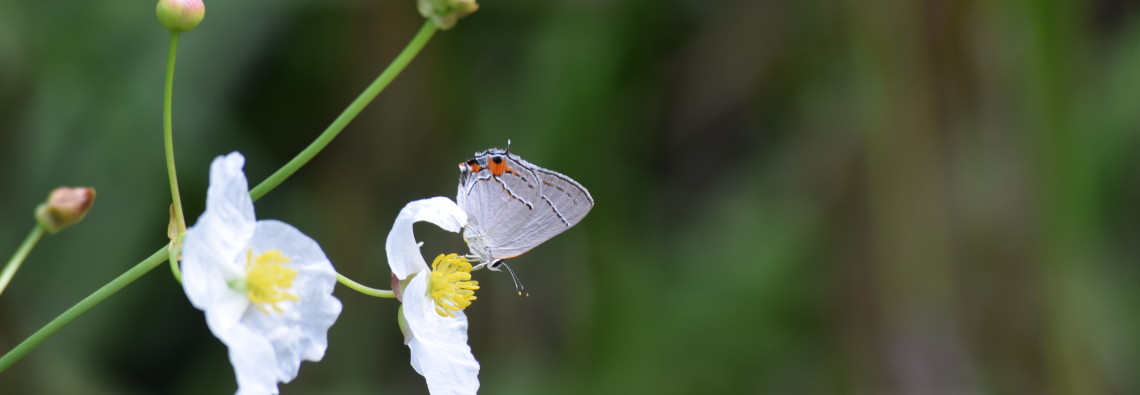
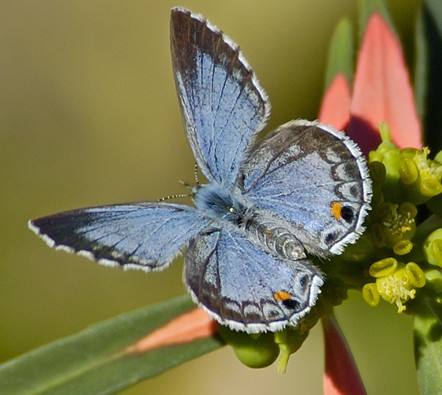
The Miami Blue Chapter of the North American Butterfly Association is located in southeast Florida and named after one of our rarest butterflies. Our chapter is working hard to meet the challenges of the 21st century as they apply to butterfly interests. The photos at the top of the page are of our rare namesake, the Miami Blue butterfly, and the only easy-to-reach location where they could be found until 2010, Bahia Honda State Park in the Florida Keys.
Help support the Miami Blue Chapter by ordering your on-line purchases through the Amazon.com. It's easy! When you make an on-line purchase, go to Amazon.com by first clicking on the amazon.com logo below. The Miami Blue Chapter will receive a small monetary rebate.